
WHAT IS AGE-RELATED
MACULAR DEGENERATION
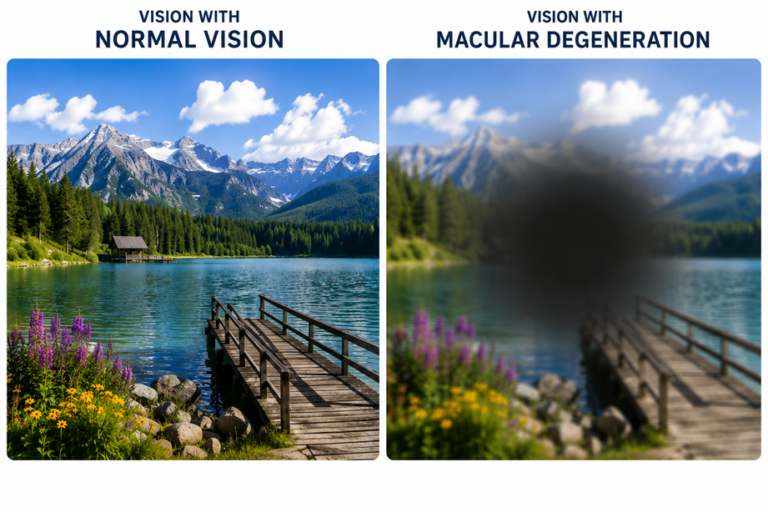
Age-related Macular Degeneration (AMD) is a chronic non-curable condition where the retina (back layer of the eye) ages faster than the rest of the body. It is a common condition affecting older patients. With AMD, the retina progressively thins out (Atrophies – “dry” AMD) and commonly develops leakage or bleeding within the retina (Wet AMD). Although the condition is incurable, there are treatment strategies available to treat both the dry and wet variants of the condition.

HEALTHY (NORMAL) RETINA

RETINA EFFECTED BY MACULAR DEGENERATION

FREQUENTLY ASKED QUESTIONS
Things To Know About Age-Related Macular Degeneration
The condition is caused by accelerated aging of the retina. The condition is partially inherited – presumably, patients are prone to develop AMD based on genetic predilection but there is also a suspected environmental and dietary component to the development.
What can I do to prevent the AMD getting worse or developing?
There are only three things to consider:
- Nutritional supplements – using a specific formulation of minerals and vitamins developed for AMD.
- Control of cardiac disease (Heart disease has been shown to be strongly associated with worsening macular degeneration).
- Stopping smoking (Smoking aggravates AMD).
The leaking form of macular degeneration can cause vision to reduce drastically in a rapid fashion. Fortunately, treatment is well established and available. For retinal leakage, the patient will require eye injections of anti-VEGF – this medication shrinks the leaking areas under the retina and dries the retina. It might require a number of injections to control the leakage, and some patients require lifelong injections, intermittently.
The condition is currently incurable, although we can slow it down with eye injections. The condition fortunately affects only the central part of the retina in the vast majority of cases. Your peripheral vision will thus always remain intact. The central part of your vision unfortunately tends to worsen over time. If the AMD starts late in life (>75yrs) you might retain enough viable central retina to maintain reasonable reading vision. Many patients unfortunately do lose their central vision over time. The effect of this is being unable to read, unable to drive and finding it difficult to recognise faces if the person is not close to them.